
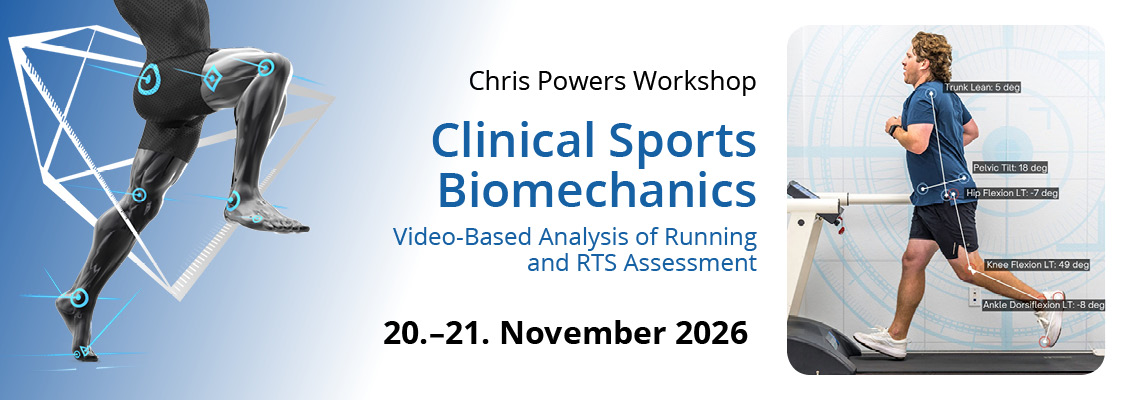
Chris Powers Workshop
Clinical Sports Biomechanics:
Video-Based Analysis of Running and RTS Assessment
Der zweitägige Workshop findet in englischer Sprache statt.
Evaluation and Treatment of the Injured Runner:
A Biomechanical Approach
Overview
Running is a demanding physical activity performed by millions of persons worldwide. Given the repetitive high-impact nature of running, many individuals who engage in this form of exercise experience pain or become injured. For the clinician, managing the injured runner can be challenging as the cause(s) of running injuries are often multifactorial. Furthermore, a thorough biomechanical evaluation is often necessary to determine underlying injury mechanism(s) in order to guide treatment decisions. This evidence-based course will address contemporary topics related to running mechanics, running-related injuries, and the rehabilitation of the injured runner. The use of video analysis as an integral part of the running examination will be emphasized, and strategies to modify running mechanics will be addressed as part of a comprehensive approach to treatment. Case studies will be utilized to promote the integration of the material presented.
Course Objectives/Learning Outcomes
At the conclusion of the course, the participant will be able to:
- Describe the biomechanics of running
- Describe current trends in running styles and footwear
- Perform a basic running evaluation using video methods
- Understand the biomechanical factors that underlie common running injuries
- Describe treatment approaches for common running injuries
Schedule
| 08:00-08:30 | Introduction |
| 08:30-10:00 | Biomechanics of Running |
| 10:00-10:15 | Break |
| 10:15-12:00 | Biomechanical causes of common running injuries |
| 12:00-01:00 | Lunch |
| 01:00-03:00 | Evaluation of the injured runner |
| 03:00-03:30 | Break |
| 03:30-05:00 | Treatment of the injured runner |
Sports Motion Analysis:
Assessing Lower Extremity Biomechanics & ACL Injury Risk
Overview
Tears of the ACL are one of the most common knee injuries sustained by individuals who engage in athletics and recreational activities. Approximately 1 in 4 young athletes who return to a high-risk sport after primary ACL reconstruction will go on to sustain a second ACL injury. Laboratory studies have identified specific movement impairments at the trunk, pelvis, hip and knee that are predictive of ACL injury. More importantly, movement impairments at the knee and hip can predict a second ACL injury.
Current return to sport criteria primarily focus on measures of knee strength and physical performance (i.e., hopping distance, agility, etc.). There is a need for a clinically feasible return to sport assessment that identifies movement impairments related to ACL injury. This gap in the clinical arena has led to the development of the video-based Movement Performance Assessment (MPA). The MPA examines movement quality across 6 sport-specific tasks (single limb and double limb), including those that involve a change of direction (i.e., lateral shuffle, side-step cutting, and deceleration).
This course will describe the assessment of lower extremity biomechanics using the MPA, with a focus on identifying movement impairments related to ACL and knee injury. Fundamental principles of injury mechanics will be presented, along with a framework for assessing lower extremity biomechanics in athletes. Implications for rehabilitation, injury prevention, and return to sport decisions will be discussed.
Course Objectives/Learning Outcomes
At the conclusion of the course, the participant will be able to:
- Describe the influence of abnormal lower extremity mechanics on knee injury (with a special focus on ACL injury).
- Perform a sport-related movement assessment that can identify these movement impairments
- Describe methods to quantify “at risk” movement impairments using 2D motion analysis.
- Develop training methods to minimize ACL injury risk
Schedule
| 08:00-08:30 | Introduction |
| 08:30-10:00 | Biomechanics of ACL injury |
| 10:00-10:15 | Break |
| 10:15-12:00 | Return to sport testing following ACL reconstruction: Introduction to the MPA |
| 12:00-01:00 | Lunch |
| 01:00-03:00 | Return to sport testing following ACL reconstruction: Demonstration |
| 03:00-03:30 | Break |
| 03:30-05:00 | Treatment & training implications |
Date
20. – 21. November 2026
Registration Fee
690 € incl. VAT
Location
 REHAZENTRUM Mittelbaden
MOTIONLAB
Dreherstr. 2/6
76437 Rastatt
Discount Rate for Combined Package
- Seminar Ganganalyse: Der Gang im Fokus | 9. Okotber 2026
- Chris Powers Workshop: Clinical Sports Biomechanics | 20.–21. November 2026
Price for both events: 839 € inkl. VAT
You will receive a confirmation email, including an invoice, within two working days of us receiving your registration. Please note that we can only confirm your place on the seminar once we have received your payment.
Cancellation by participants
If a participant cancels their registration, the following conditions apply:
Cancellations must be made in writing. The date on which Velamed receives the cancellation is the date relevant for the cancellation policy.
The following cancellation terms apply:
Up to 14 days before the event: free cancellation
Up to 7 days before the event: 50% of the participation fee will be refunded
From 6 days before the event or in the event of a no-show: no refund of the participation fee will be given.
An alternative participant may also be nominated. It is not possible to terminate the contract once the event has begun.
Cancellation by Velamed
The seminar will only take place if there is a minimum of 5 participants.

Christopher M. Powers
PT, PhD, FACSM, FAPTA
Dr. Chris Powers, Gründer des Movement Performance Institute, ist ein führender Experte auf dem Gebiet der Biomechanik und Bewegungsanalyse. Mit seinem reichen Erfahrungsschatz und einer soliden Forschungsgrundlage hat Dr. Powers Methoden entwickelt, die sich auf die Optimierung der menschlichen Bewegung konzentrieren, um die Leistung zu verbessern und das Verletzungsrisiko zu verringern. Seine innovativen Ansätze haben zahllose Praktiker auf diesem Gebiet beeinflusst, und das Powers Running Assessment ist ein Beweis für sein Engagement, die Biomechanik des Laufens voranzubringen.
Was ist die Powers Laufanalyse »